Who they are
Telkomsel is Indonesia’s largest telecommunications company, serving more than 190 million subscribers on the nation’s widest 4G and 5G network with a large, complex organization.
02 / Case study · Telkomsel
Making competency mapping reviewable.

Telkomsel is Indonesia’s largest telecommunications company, serving more than 190 million subscribers on the nation’s widest 4G and 5G network with a large, complex organization.
To speed up an organizational restructuring, Telkomsel needed 19,000 job positions mapped to standardized competency catalogs, with confidence scores and validation rules instead of manual interpretation.
Telkomsel’s teams had to interpret organizational hierarchies and repeatedly cross-reference catalog rules to map job positions. Manual classification created bottlenecks and inconsistent mappings, especially whenever a catalog changed.
What it was costing them. Manual mapping of 19,000 roles meant interpreting complex hierarchies by hand and cross-referencing catalog rules again and again. Every catalog update brought inconsistent classifications and cascading rework.
The portfolio records the mapping cycle shrinking from 50 working days to 3 days.
Teams follow each run on a processing dashboard and receive export-ready Excel outputs.
Results stay inside the approved catalog, so teams move to implementation with fewer corrections.
Reviewers see why a role was matched, not only what it was matched to.
Outcomes as recorded in the QuantumByte enterprise case-study portfolio (2025). The 50-to-3-day figure is the engagement’s own reporting, not an independent audit. The portfolio’s separate percentage claim is omitted because it does not reconcile with those numbers.
Designed solutions
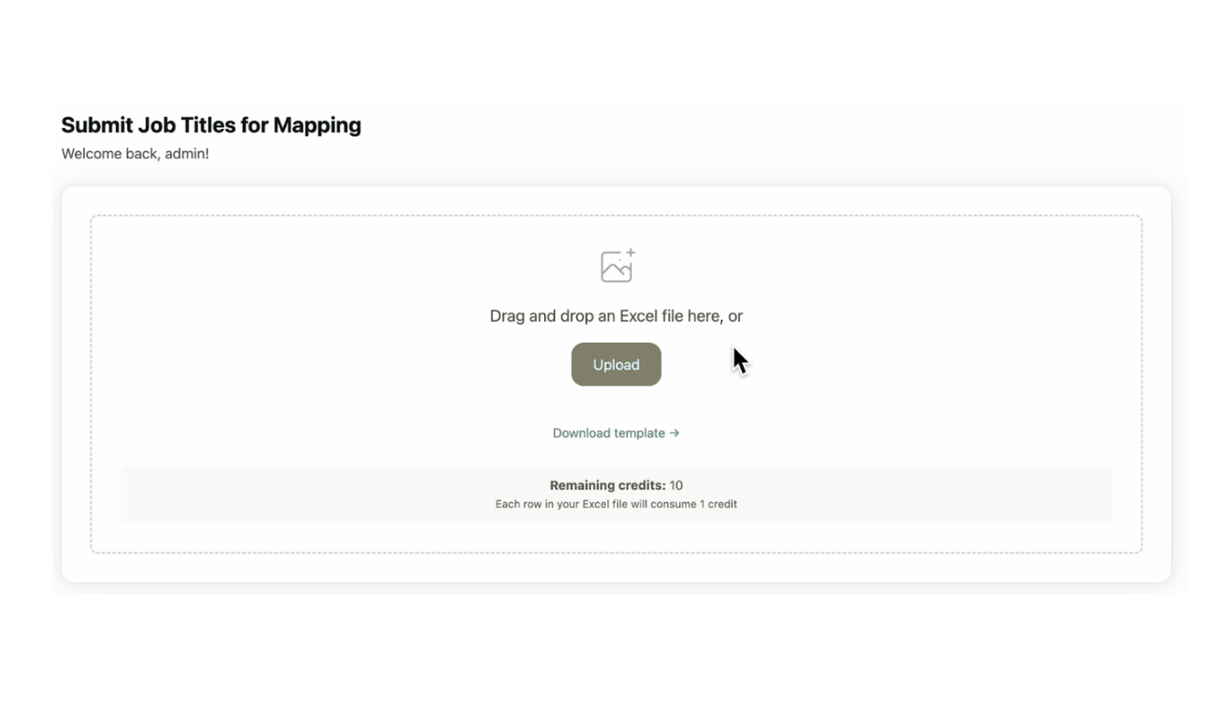
Teams upload the Excel template; the system validates the data and extracts the role information needed for matching.
AI extracts job functions and relevant context, while predefined rules adjust the matching weights.
Outputs are limited to entries in the existing competency catalog, so results use the organization’s approved vocabulary.
Each match carries confidence information and reasoning, so reviewers can judge it quickly.
A processing dashboard shows job status and results while a mapping run is underway.
Reviewable results and Excel exports feed technical-competence planning and implementation.
The workflow
The team starts with the template and uploads the role spreadsheet.
The system checks inputs and extracts the job-function context.
Roles are matched against the approved catalog using predefined constraints and weights.
Reviewers inspect confidence, reasoning and processing results.
The team downloads the mapping for organizational planning and implementation.
The interfaces
Where else this applies
| Industry | Fit | Why |
|---|---|---|
| Telecommunications | High | Restructuring across large, evolving role families in network, IT and digital needs rapid, catalog-compliant mapping. |
| Financial services | High | Governance-heavy environments with audit trails and policy rules benefit from constrained, explainable matching. |
| Healthcare | Medium | Standardized clinical and administrative competencies; rule-based constraints reduce compliance risk. |
| Retail and e-commerce | Medium | Large frontline workforces with seasonal hiring benefit from consistent role-to-competency mapping. |
| Government and public sector | Medium | Civil-service reforms need catalog-compliant mapping across many agencies at once. |
Kevin led delivery with the Quantum team: the ingestion and review workflow, the catalog-only matching design and the reporting outputs.
Tell me where the workflow breaks today and who carries it. I’ll tell you what the smallest useful slice would be, and whether I’m the right person to build it.