Who they are
Polri is Indonesia’s national police force, serving a country of more than 270 million people through hundreds of units, each with its own systems and software vendors.
01 / Case study · Polri
One app for a hundred, without taking anyone’s keys.
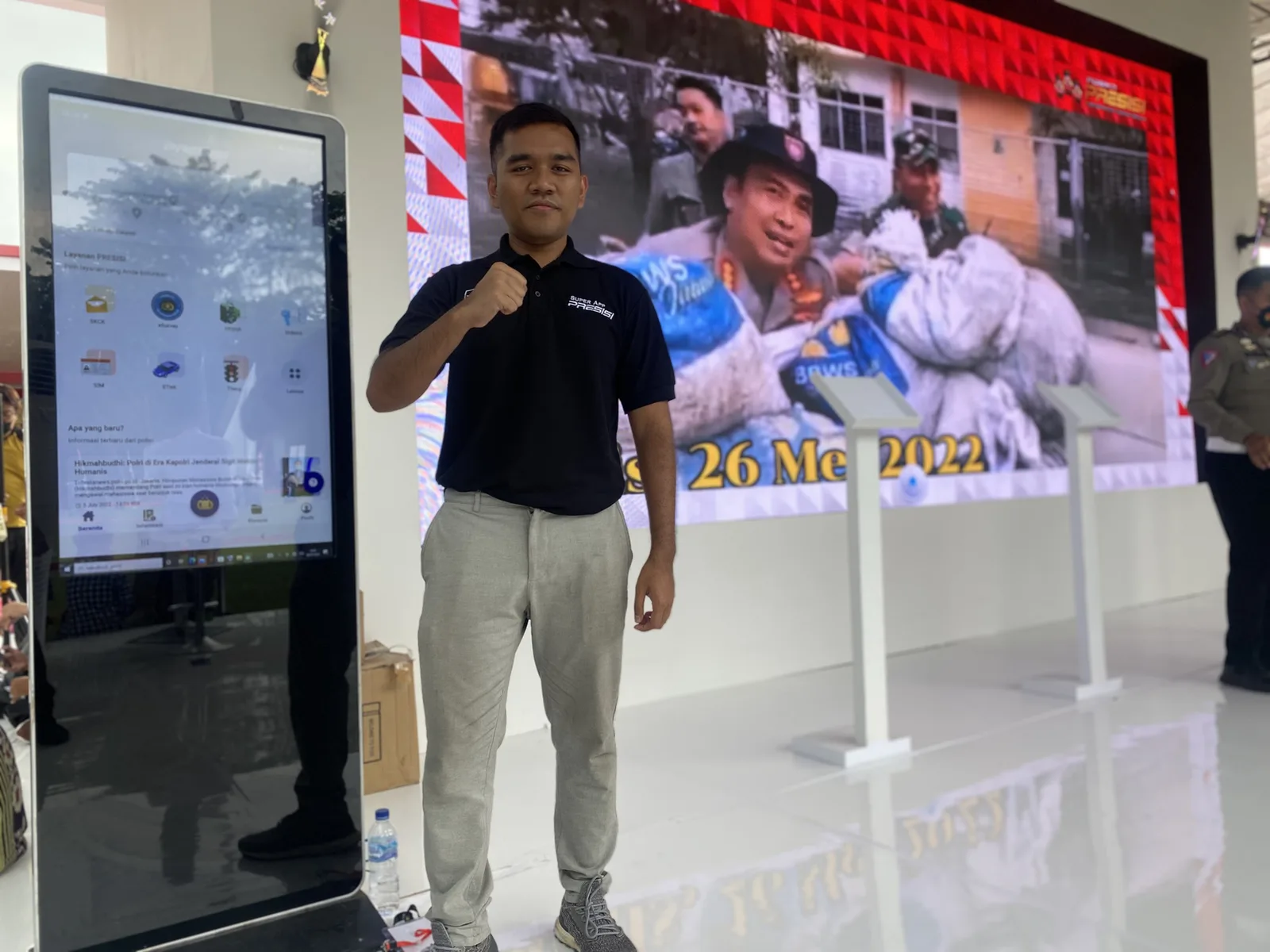
Polri is Indonesia’s national police force, serving a country of more than 270 million people through hundreds of units, each with its own systems and software vendors.
Bring more than 100 separate applications behind one experience officers and citizens could actually use, without the programme stalling over who owns what.
More than 100 applications, each with its own vendor, budget and owning unit. Officers moved between apps to finish one job and citizens had no single door. The brief treated it as an integration problem when the real obstacle was the distribution of control.
What it was costing them. A previous attempt had stalled. Vendors read a single integrated system as handing over the keys to their kingdom, so a technically central platform would still have failed to win cooperation.
Each unit could contribute its own application through the shared builder, so participation no longer meant surrendering ownership.
Reported for the product across app stores. These are product downloads, not downloads personally acquired.
The Indonesian App Store rating was separately corroborated.
Reported by Kevin; the endorsement moved a stalled approach forward.
Public services that had been scattered across separate apps arrived in a single place.
Figures are as reported by Kevin and the QuantumByte materials, with the App Store rating separately corroborated. The original brief covered more than 100 applications; that does not establish how many were finally integrated.
Designed solutions
An initially empty application that units could publish into, rather than a finished system they had to adopt.
Each unit and its vendor could build their own application inside the shared platform, without handing over their source or their budget.
The commercial and ownership terms were designed alongside the software, so joining was an option rather than a surrender.
Citizen-facing services arrived in a single app instead of a directory of separate downloads.
The daily jobs officers moved between apps to finish were brought behind one login.
New unit applications could ship into the super app without rebuilding the whole platform.
The workflow
A unit and its vendor describe the application they already run or want.
The low-code builder produces it within the super app’s rules and design.
The application appears for the officers or citizens who need it.
People finish the job in one place instead of moving between apps.
Changes ship through the same builder rather than a fresh vendor cycle.
Where else this applies
| Industry | Fit | Why |
|---|---|---|
| Law enforcement | High | The same participation model fits any force whose units already run their own systems. |
| Emergency response | High | Multiple agencies must act in one place while keeping their own command and budgets. |
| Government services | High | Citizen-facing services scattered across ministries need one door without central seizure of ownership. |
| Large enterprise IT | Medium | Divisions with their own vendors face the same integration standoff at a smaller scale. |
| Utilities and infrastructure | Emerging | Regional operators could publish into a shared operational app, though procurement cycles are slow. |
Kevin reframed the integration strategy around vendor participation and led the product with the Quantum team.
Tell me where the workflow breaks today and who carries it. I’ll tell you what the smallest useful slice would be, and whether I’m the right person to build it.