Who they are
Polri, the Indonesian National Police, leads public safety for the country. Sistem Operasi Terpadu (SOT) is its unified command system for planning and running operations across units.
06 / Case study · Sistem Operasi Terpadu · Polri
A shared picture for complex operations.
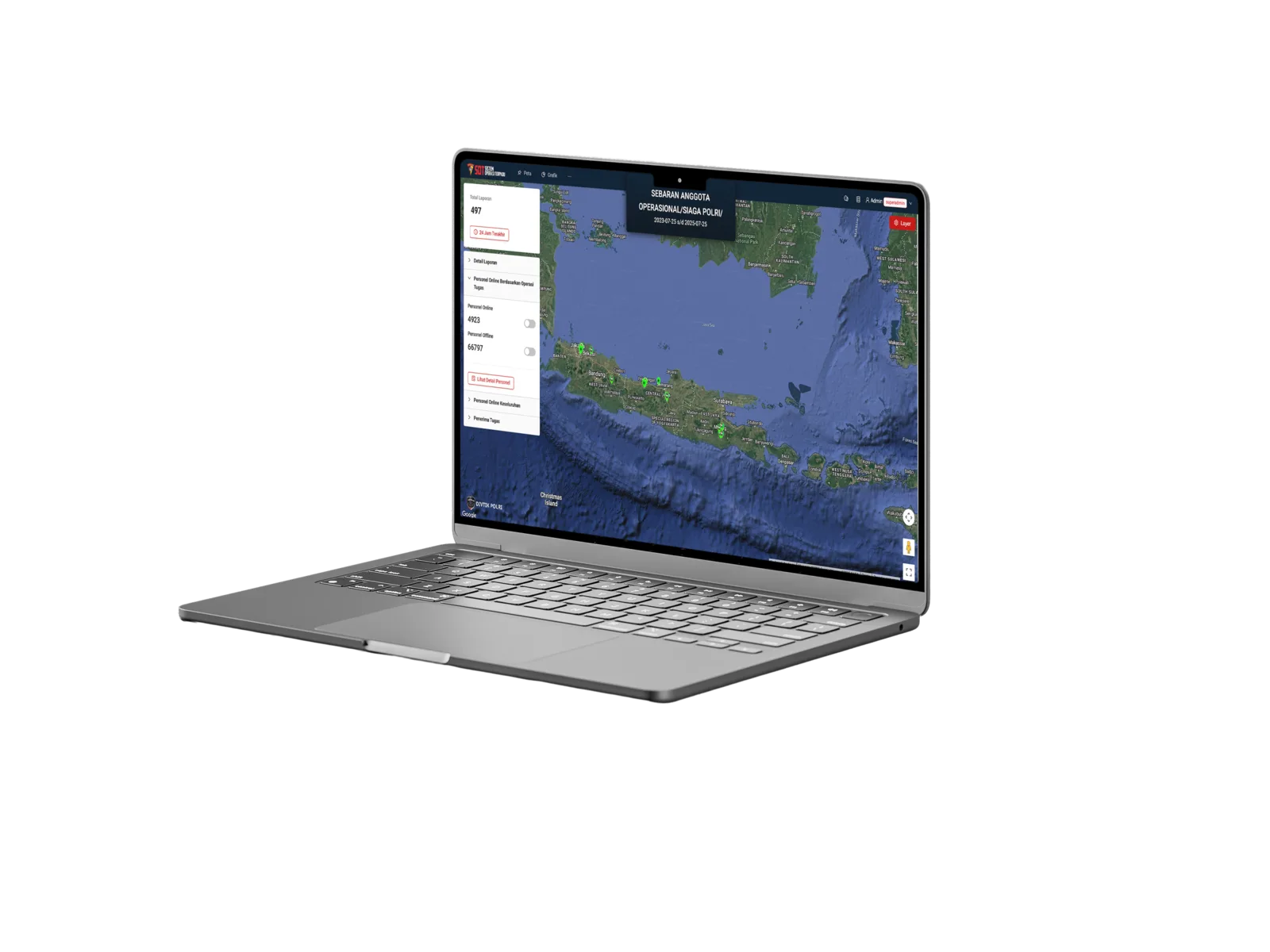
Polri, the Indonesian National Police, leads public safety for the country. Sistem Operasi Terpadu (SOT) is its unified command system for planning and running operations across units.
To speed up incident response, Polri wanted command unified across units: one system combining task assignment, 3D planning, live field status, communication and digital reporting.
Complex operations required coordination across many units while communications and field updates stayed fragmented. Commanders needed the command view joined to the field workflow so assignments, status and reports could be reviewed together.
What it was costing them. Complex missions strained coordination and caused delays. Disjointed communication, manual tracking and weak accountability got in the way of rapid, effective responses.
Structured reports return field information to a common view for review.
Outcomes as recorded in the QuantumByte enterprise case-study portfolio (2025). The percentages are the engagement’s own reporting, not an independent audit.
Designed solutions
Commanders delegate tasks through one central workflow that makes operational responsibility visible.
A spatial planning interface supports mission preparation and visualization.
A mobile-connected workflow brings personnel status and field updates into the operational view.
Integrated communication connects coordinators and field teams.
Structured reports bring field information back into a common view for review and follow-up.
The workflow
Commanders set the operational context and review the spatial view.
Tasks are delegated through the shared command workflow.
Coordinators monitor status and communicate with teams as the work develops.
Digital reports are collected for follow-up and situational awareness.
Where else this applies
| Industry | Fit | Why |
|---|---|---|
| Law enforcement | High | Unified command and tracking improve public safety and response. |
| Emergency response | High | Real-time coordination improves disaster-management efficiency. |
| Military operations | High | Precise planning and communication improve mission outcomes. |
| Transportation security | Medium | Better monitoring supports logistics security, though adoption varies. |
| Public utilities | Emerging | Streamlined operations help crisis response, at a smaller scale. |
Kevin led delivery with the Quantum team: the command workflow, the spatial planning interface and the field-to-command reporting loop.
Tell me where the workflow breaks today and who carries it. I’ll tell you what the smallest useful slice would be, and whether I’m the right person to build it.